Strategisches Domain Driven Design: Große Domänen aufteilen
Wie Subdomains, Bounded Contexts und Context Maps große Domänen in unabhängig entwickelbare Bereiche aufteilen.
Software Engineer from Freiburg, Germany
Wie Subdomains, Bounded Contexts und Context Maps große Domänen in unabhängig entwickelbare Bereiche aufteilen.
Entity, Value Object, Aggregate, Repository und Domain Event: die fünf Bausteine, mit denen taktisches DDD Fachlogik im Code abbildet.
Wie Domain Driven Design die Lücke zwischen Fachabteilung und Code schließt, mit Ubiquitous Language, Bounded Contexts und taktischen Bausteinen.
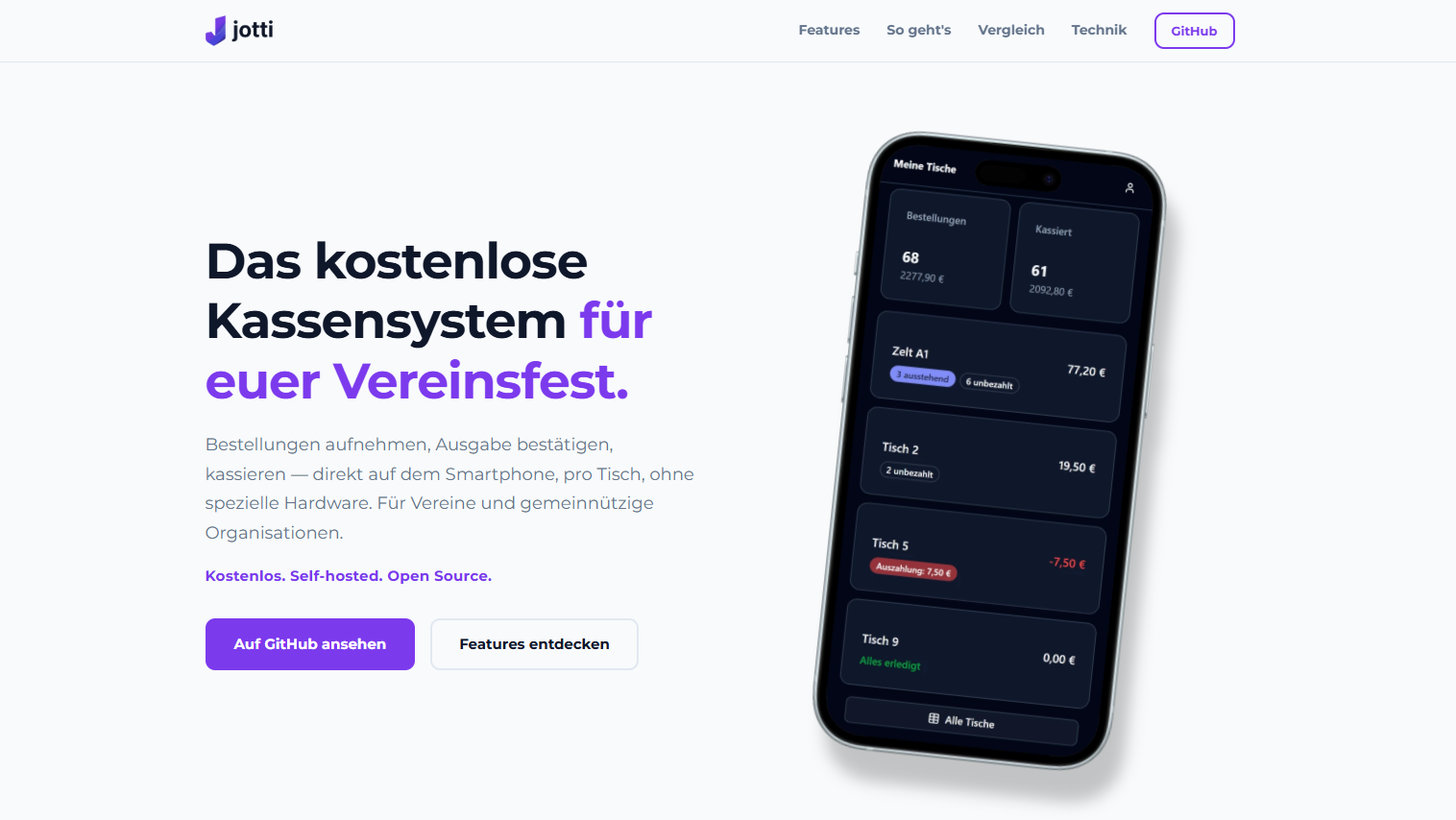
jotti is a free, source-available mobile point-of-sale system for clubs and non-profit organizations, built for Vereinsfeste, Christmas markets, and concerts. As a former club board member myself, I know Vereinsfeste from behind the cash box. Service staff take orders, confirm handout, collect payment, and handle cancellations straight from their own smartphones: table by table, all in the browser. No special hardware, no cloud subscription, no payment gateway. And it's built for Germany's cash-register regulation (KassenSichV): jotti ships the fiscal building blocks: a cloud TSE that signs every transaction, receipts per § 146a AO, an append-only cash journal, and a DSFinV-K export for the tax authorities. Self-hosted via Docker, jotti lets admins manage products, tables, and users, prints receipts at the counter, handles cash sessions with a proper daily close, and breaks down revenue per table and per staff member, all backed by an audit-proof, event-sourced history.
The Haufe Akademie is the training and education division of Haufe Group. Since 2024 I have been part of a Scrum team building technical solutions for the company.
Idana is a German startup that provides a digital assistant for the healthcare sector. I joined the team as a fullstack developer and grew into a team lead position, leading a team of five developers, including people management. I led the migration of the JavaScript backend to a Go architecture and measurably improved team satisfaction along the way.
A location-based social game for Freiburg that I once built an MVP for. The idea was to create a game where users can explore the city and collect points by visiting different locations.
A Quizduell-like game with questions about countries, capitals and flags where users can challenge each other. Developed for my roommates as a Progressive Web App with the MERN Stack.
A native android app to learn and play sudoku puzzles. I started this project in early 2016 because I wanted to know how native app development works. After publishing the first version I made a total revamp including a new design and a Sudoku of the Week.
For the Germany-wide online hackathon #WirVsVirus, my team designed and prototyped an app to support local bars and cafes during the Covid-19 crisis.
As part of a student project a fellow student and I hacked a coffee machine to accept orders via wifi. We also built a robot arm to serve cups and improved some sensors.
Back in 2015 I dreamed of being a game developer. So I decided to try out the Unreal Engine. After completing a tutorial I created this runner game. I also composed the music, created the game sounds and some textures.
A functional mockup for a board games community app based on Framework7 and Cordova/Phonegap I designed for a friend's student project.
A Java GUI application to solve Sudokus, created out of curiosity back in 2016. I wanted to find out if I could come up with a Sudoku-solving algorithm on my own.
After completing an online course about Machine Learning I played around with the MNIST-dataset, implemented my own version of a genetic algorithm and coded a feed-forward neural network.
In 2018 I developed a native android app, a hybrid app and several features for the web backend of a community platform.
As a webdesign freelancer I designed and (hand-)coded the website for an equestrian farm. Later they asked me to help build an online presence. That's kind of how I got into online marketing.
As my first startup-like project, a friend and I opened a pop-up store before Christmas 2015. We offered custom portrait art and showed some art hacking experiments at our opening.
In Freiburg there's a bridge called Wiwili and it has a bicycle counter built into the ground. I downloaded the data from FRITZ (the open data platform of Freiburg) and used it to play around with D3.js.
A simple website maker I made to learn some Node.js stuff. Sadly, I lost the final version of my code and this repo only represents the alpha version.
As an experiment in online marketing I invented an art magazine startup, set up an online shop with Shopify and used Instagram for marketing.
I created this module as part of the What The Flag project and published it to NPM just out of curiosity. It lets you create questions and quizzes about countries, flags and capitals. Later, I used this as a training project for testing and Travis CI.